
Newsroom
Algorithmic Fairness
-
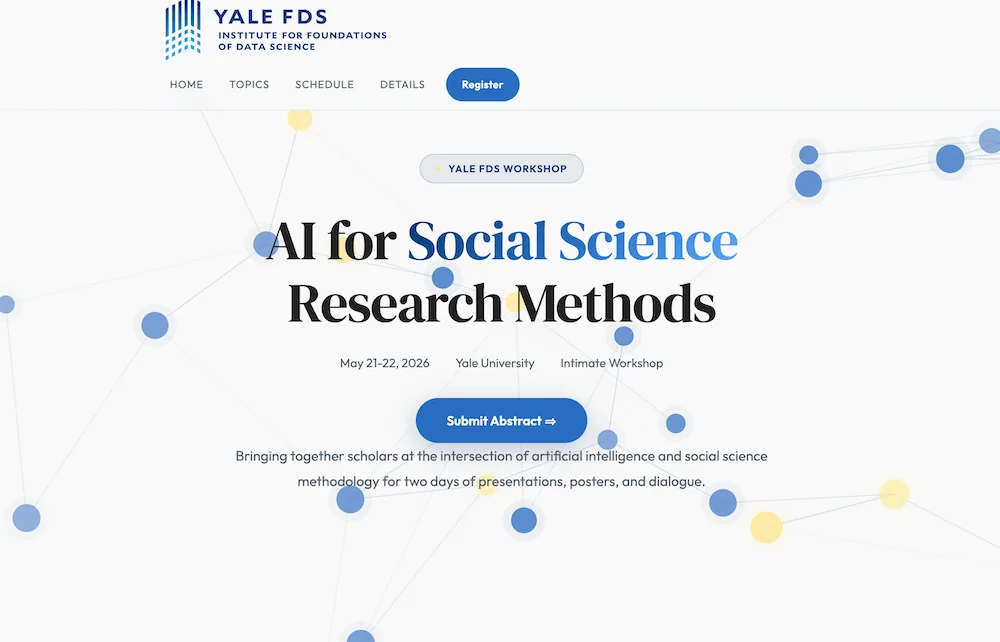
FDS Workshop: AI for Social Science Research Methods
Social scientists are increasingly incorporating AI into their designs, data collection, analyses, and workflows. Alongside rapid adoption, important methodological questions remain: What are the principled approaches to validating measurements via AI tools? To what extent are AI-generated observations interchangeable with those from human respondents — and what does that mean for the future of survey…
-
FDS Colloquium: Jamie Tucker-Foltz (Yale), “Random Redistricting via Random Walks”
Abstract: A widely-used method for assessing fairness in political redistricting is to generate a massive ensemble of “random” redistricting maps to develop a statistical baseline, i.e., a null model for what an unbiased map-maker would produce. State-of-the-art algorithms accomplish this task by sampling random spanning trees on the underlying graph of geographical subunits and removing…
-

FDS Workshop: New Directions in Social Algorithms Research
As social media algorithms increasingly mediate social experiences, there has been a rapid increase in research on the effects of how these algorithms are configured, alternatives to engagement-centric models of content ranking, and algorithmic approaches to content moderation such as Community Notes. This workshop brings together leading experts in the area to foster collaborations and…
-
FDS Colloquium: Cynthia Dwork (Harvard), “Outcome Indistinguishability and its Diverse Applications”
Abstract: Outcome Indistinguishability, a notion from algorithmic fairness with roots in complexity theory, frames learning not as loss minimization – the dominant paradigm in supervised machine learning — but instead as satisfaction of a collection of “indistinguishability” constraints. Outcome Indistinguishability considers two alternate worlds on individual-outcome pairs: in the natural world, individuals’ outcomes are generated by…
-
FDS Colloquium: Bhramar Mukherjee (Yale), “Analysis of “Big” Real-World Health Care Data: Promises and Perils”
Speaker: Bhramar Mukherjee, Ph.D.Senior Associate Dean of Public Health Data Science and Data EquityAnna M.R Lauder Professor of BiostatisticsProfessor of Epidemiology (Chronic Diseases) and of Statistics and Data ScienceYale University Optional Zoom link: https://yale.zoom.us/j/94323793445 Analysis of “Big” Real-World Health Care Data: Promises and Perils Abstract: Using administrative patient-care data such as Electronic Health Records and…
-
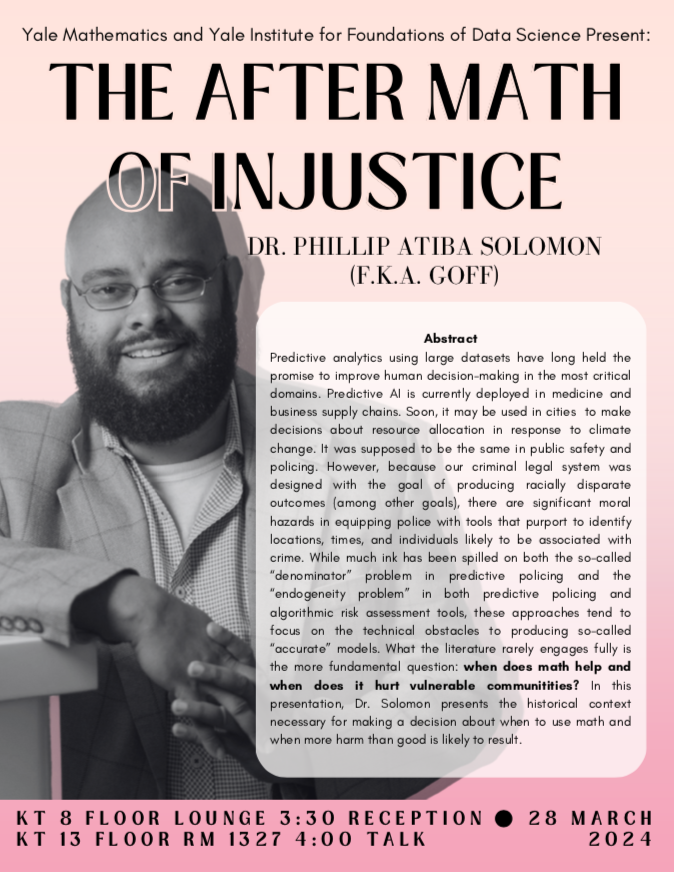
FDS x Math Colloquium: Phillip Atiba Solomon (f.k.a. Goff), “The After Math of Injustice”
Speaker: Phillip Atiba Solomon f.k.a. GoffChair and Carl I. Hovland Professor of African American Studies and Professor of Psychology Thursday, March 28, 20243:30pm: Tea reception, Kline 8th Floor Lounge4:00pm: Talk, Kline 13th Floor, Room 1327 Title: The After Math of Injustice Abstract: Predictive analytics using large datasets have long held the promise to improve human…