
Newsroom
Generative AI
-
Yale’s Sinho Chewi Shares ICML 2026 Outstanding Paper Award
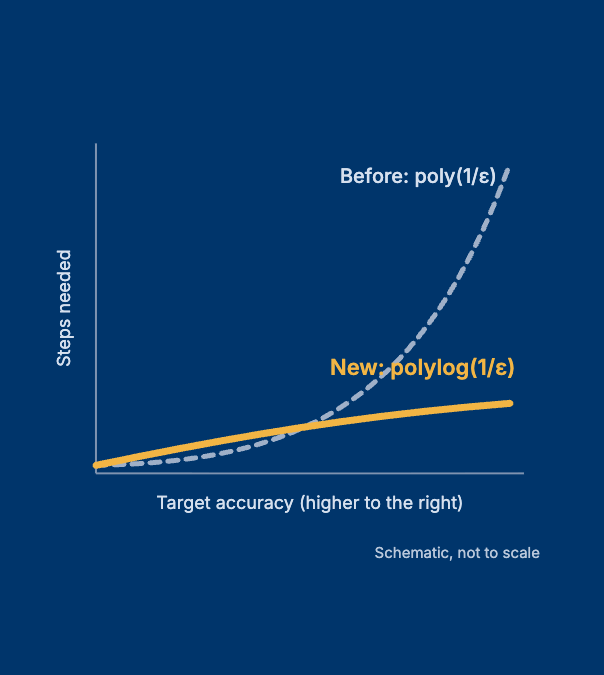
A paper co-authored by Sinho Chewi, “High-Accuracy Sampling for Diffusion Models and Log-Concave Distributions,” written with Fan Chen, Constantinos Daskalakis, and Alexander Rakhlin, received an ICML 2026 Outstanding Paper Award, one of only two papers to earn the top honor at this year’s International Conference on Machine Learning. Chewi is an Assistant Professor of Statistics…
-
How to Generate and Verify LLM-Generated Lean Proofs for Your Mathematical Needs
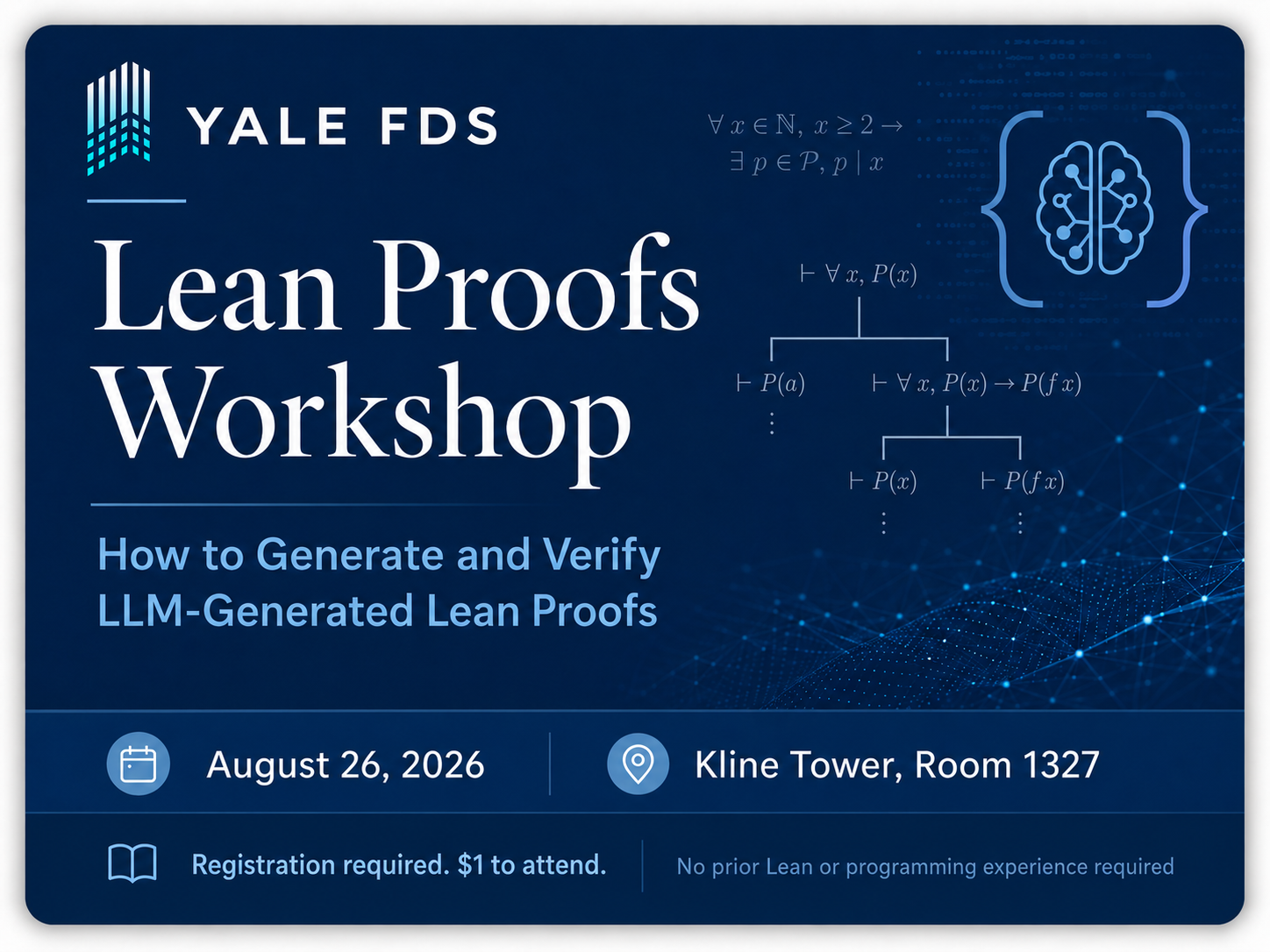
A hands-on workshop on using large language models and Lean to formalize mathematical claims, audit generated proofs, and determine whether a machine-verified result actually says what you intended. When Lean says a proof is correct, what exactly has been proved? Large language models can translate mathematical arguments into Lean, but a proof that compiles is…
-
FDS Seminar: Akhil Premkumar (UChicago), “An information theoretic view of machine learning”
Abstract: Diffusion models serve as a bridge between generative AI and information theory. These models have demonstrated a remarkable ability to learn high-dimensional continuous distributions, like images and video, from relatively small training datasets. They can do this because they learn the ensemble statistics of the entire dataset, allowing them to identify long wavelength correlations between…
-
Research in Motion: Nicole Immorlica (Microsoft Research) “The Economic Impacts of Generative AI”
Co-sponsored by CADMY, FDS, and Tsai CITY Speaker bio: Nicole Immorlica is a senior principal researcher at Microsoft Research New England (MSR NE) where she leads the economics and computation group. She received her BS in 2000, MEng in 2001 and PhD in 2005 in theoretical computer science from MIT in Cambridge, MA. She joined…
-
S&DS Colloquium: Thuy-Duong “June” Vuong (Miller Institute, Berkeley), “Efficiently learning and sampling from multimodal distributions using data-based initialization”
Abstract: Learning to sample is a central task in generative AI: the goal is to generate (infinitely many more) samples from a target distribution $\mu$ given a small number of samples from $\mu.$ It is well-known that traditional algorithms such as Glauber or Langevin dynamics are highly inefficient when the target distribution is multimodal, as they…
-
FDS x Applied Physics Colloquium: Grant Rotskoff (Stanford), “Efficient variational inference with generative models”
Abstract: Neural networks continue to surprise us with their remarkable capabilities for high-dimensional function approximation. Applications of machine learning now pervade essentially every scientific discipline, but predictive models to describe the optimization dynamics, inference properties, and flexibility of modern neural networks remain limited. In this talk, I will introduce several approaches to both analyzing and…