
Newsroom
Machine Learning
-
FDS Colloquium: Purnamrita Sarkar (UT Austin)
Speaker bio: Purnamrita Sarkar is an associate professor of Statistics at the University of Texas at Austin, where she works at the intersection of high-dimensional statistics, optimization, and machine learning theory. She is a co-PI in EnCORE: Institute for Emerging CORE Methods of Data Science and is affiliated with the Institute for Foundations of Machine…
-
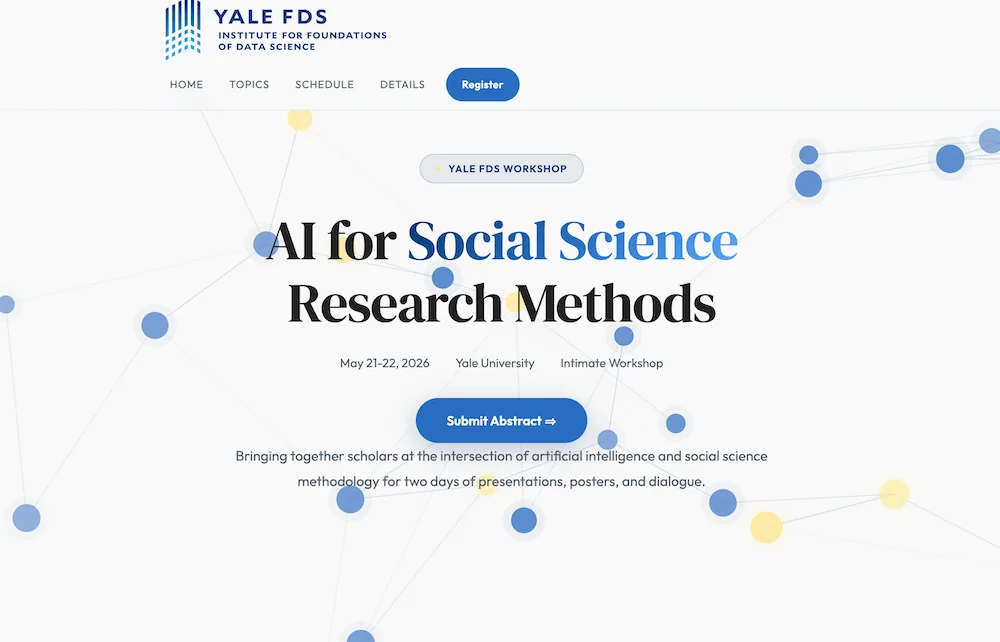
FDS Workshop: AI for Social Science Research Methods
Social scientists are increasingly incorporating AI into their designs, data collection, analyses, and workflows. Alongside rapid adoption, important methodological questions remain: What are the principled approaches to validating measurements via AI tools? To what extent are AI-generated observations interchangeable with those from human respondents — and what does that mean for the future of survey…
-
FDS Seminar: Lingjing Kong (CMU), “Causal AI for Transferable, Interpretable, and Controllable Machine Learning”
Zoom Password: 123 Abstract: Foundation models are rapidly becoming capable assistants for knowledge work, but their deployment in real settings is limited by three gaps: they do not transfer reliably across environments, their internal reasoning is opaque, and their behavior is hard to precisely control. In this talk, I argue that these limitations are not…
-
FDS Colloquium: Cynthia Rudin (Duke), “Many Good Models Leads To…”
Abstract: As it turns out, many good models leads to amazing things! The Rashomon Effect, coined by Leo Breiman, describes the phenomenon that there exist many equally good predictive models for the same dataset. This phenomenon happens for many real datasets and when it does, it sparks both magic and consternation, but mostly magic. In…
-

Lu Lu on MIT Technology Review’s Innovators Under 35 list
We are proud to announce that Prof. Lu Lu has been named to the MIT Technology Review’s Innovators Under 35 list for the Asia Pacific region. This award recognizes his groundbreaking work in operator learning and significantly improved accuracy, efficiency, and generalization ability of the model in specific fields. You can learn more about this…