
Newsroom
Statsitical Learning Theory
-
FDS Colloquium: John Duchi (Stanford), “Finding Stationary Points in Stochastic Convex Optimization: Why and How”
Abstract: In this talk, I will discuss finding stationary points of possibly non-differentiable stochastic convex functions. Motivation for solving such problems arises in modern “distribution free” statistical learning problems. We will highlight some of the challenges of solving such problems, including that subgradients of stochastic convex functions do not converge uniformly, and also demonstrate some…
-
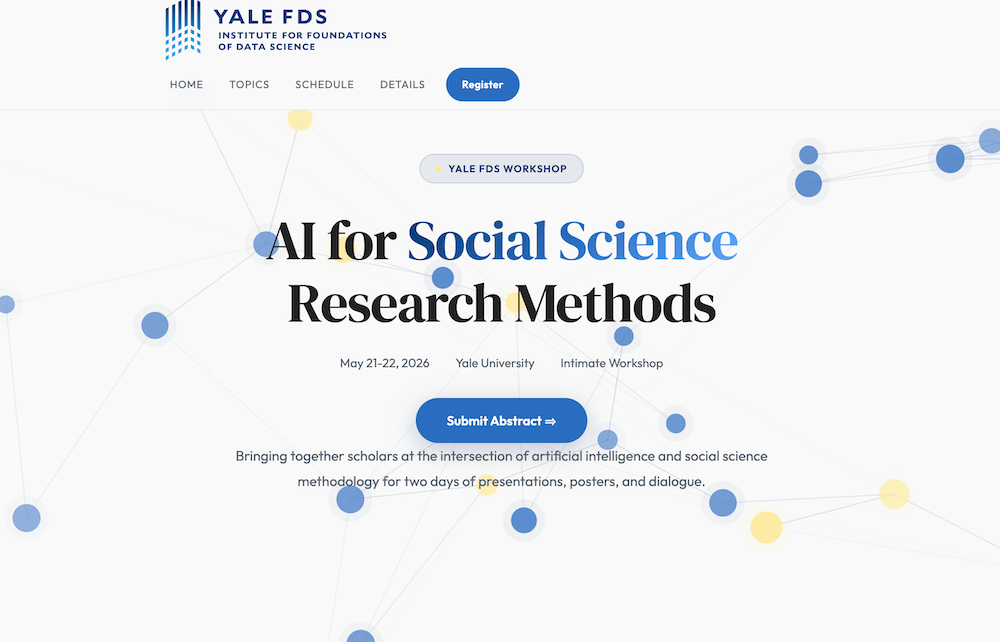
FDS Workshop: AI for Social Science Research Methods
Social scientists are increasingly incorporating AI into their designs, data collection, analyses, and workflows. Alongside rapid adoption, important methodological questions remain: What are the principled approaches to validating measurements via AI tools? To what extent are AI-generated observations interchangeable with those from human respondents — and what does that mean for the future of survey…
-

Lu Lu on MIT Technology Review’s Innovators Under 35 list
We are proud to announce that Prof. Lu Lu has been named to the MIT Technology Review’s Innovators Under 35 list for the Asia Pacific region. This award recognizes his groundbreaking work in operator learning and significantly improved accuracy, efficiency, and generalization ability of the model in specific fields. You can learn more about this…
-
Dissertation Defense: Anay Mehrotra, “Learning Theory in the Wild: Foundations of Missing Data and Language Generation”
Abstract: What can be learned from data? This fundamental question in machine learning takes on new complexity in modern pipelines where classical assumptions fail—both in how data is generated and in how learning objectives are defined. This thesis develops foundations for learning under these complex conditions, revealing how violations of traditional assumptions transform not just…
-
S&DS Seminar: Jingfeng Wu (Berkeley), “Gradient Descent Dominates Ridge: A Statistical View on Implicit Regularization”
Talk summary: A key puzzle in deep learning is how simple gradient methods find generalizable solutions without explicit regularization. This talk discusses the implicit regularization of gradient descent (GD) through the lens of statistical dominance. Using least squares as a clean proxy, we present two surprising findings. First, GD dominates ridge regression. For any well-specified…
-
FDS Colloquium: Bento Natura (Columbia), “Faster Exact Linear Programming”
Optional Zoom link: https://yale.zoom.us/j/99342713421 Abstract: We present a novel algorithm to solve various subclasses of linear programs, with a particular focus on strongly polynomial algorithms—those that operate in polynomial time relative to the problem’s dimension. Although subclasses like bipartite matching and maximum flow are known to be solvable in strongly polynomial time, the existence of…