
Newsroom
Causal Inference
-
Dissertation Defense: Anay Mehrotra, “Learning Theory in the Wild: Foundations of Missing Data and Language Generation”
Abstract: What can be learned from data? This fundamental question in machine learning takes on new complexity in modern pipelines where classical assumptions fail—both in how data is generated and in how learning objectives are defined. This thesis develops foundations for learning under these complex conditions, revealing how violations of traditional assumptions transform not just…
-
S&DS Seminar: Adam Block (Columbia), “Scaling Inference-Time Compute: From Self-Improvement to Pessimism”
Abstract: Language models increasingly rely on scaling inference-time computation to achieve state-of-the-art performance on a growing number of reasoning tasks. A popular paradigm for such computational scaling is Best-of-N (BoN) sampling, where a model generates multiple candidate responses to a given question and selects the one among them as the most likely to be correct.…
-
-
FDS Colloquium: Anay Mehrotra (Yale), “What Makes Treatment Effects Identifiable? Characterizations and Estimators Beyond Unconfoundedness”
Talk summary: Sometimes, like when studying the effects of smoking, it is impossible to run a randomized control trial and we must rely on observational data—where we observe who chose to receive treatment but do not control the assignment of the treatment. This leads to a fundamental challenge: we only see one outcome per individual…
-
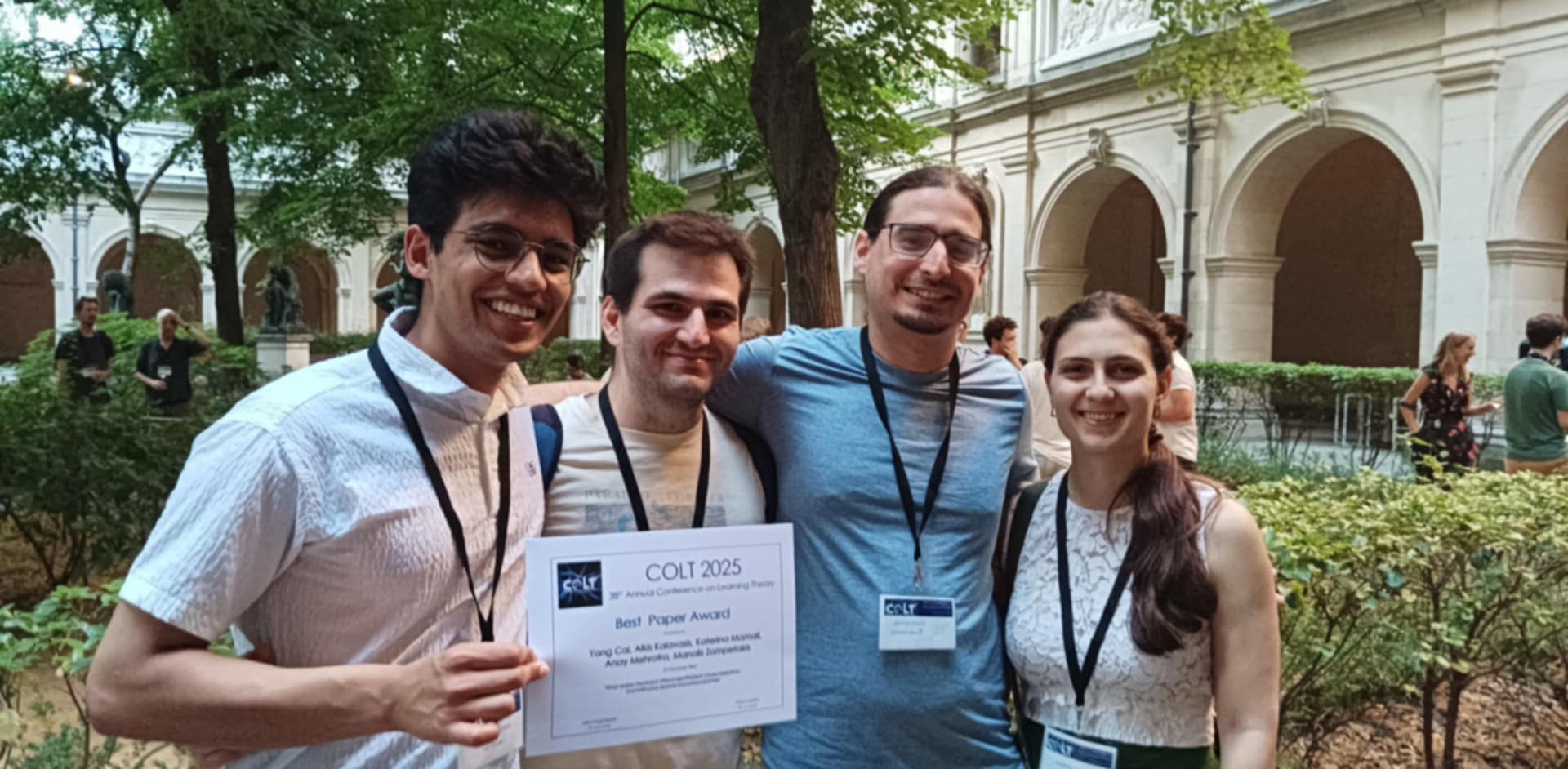
Yale FDS Researchers Win Best Paper at COLT 2025 for Foundational Work in Causal Inference
Colt 2025 Best Paper Award went to an all-Yale team. Pictured left to right: Anay Mehrotra, Alkis Kalavasis (FDS Postdoc), Manolis Zampetakis, and Katerina Mamali. Not pictured: Yang Cai.
-
FDS Colloquium: Kristina Gligoric (Stanford), “Supporting policies and interventions to promote healthy and sustainable habits”
Abstract: Data science tools create new opportunities to assist policy-makers. For example, enabling healthy and sustainable diets is key to addressing preventable diseases and climate change. How can data science methods help policy-makers in developing interventions that address these and other societal challenges? I develop causal inference tools for explaining decision-making and LLM methods for…
